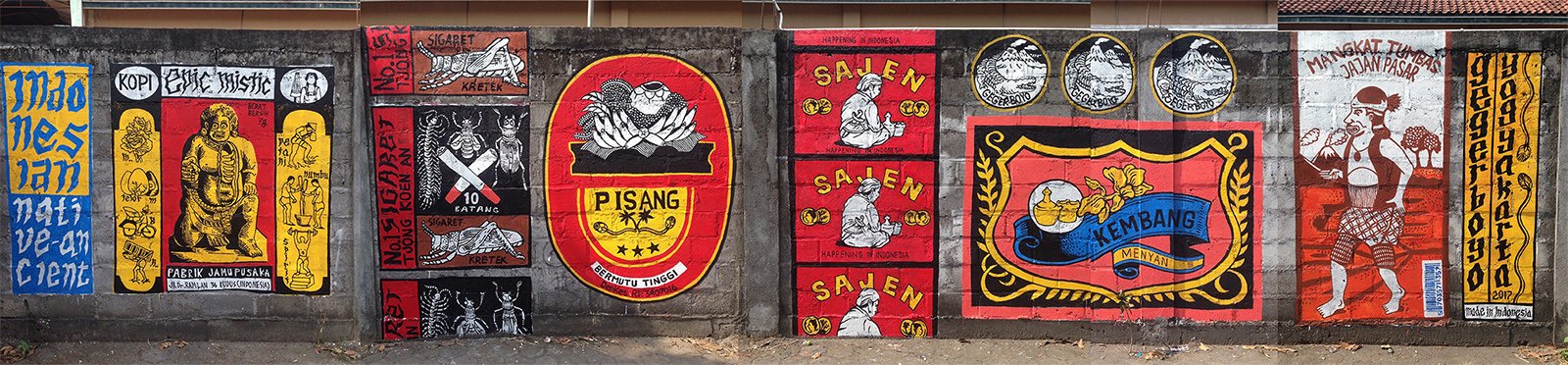
Mixed media installation:
Batik, Buffalo skin shadow puppets, and iron installation.
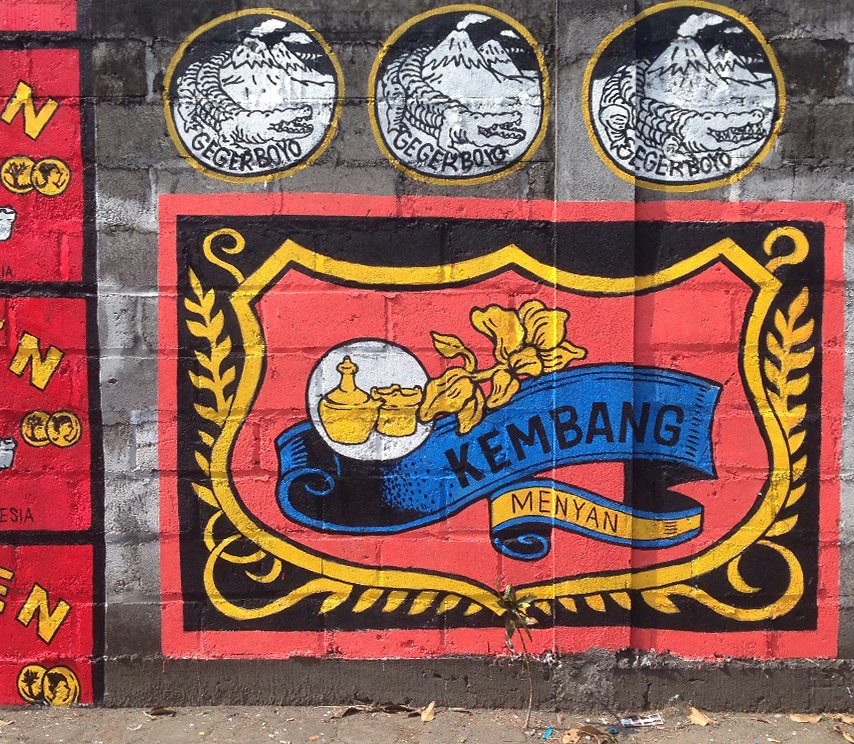
Red Typhoon: The Four Acts is an installation by Gegerboyo that presents four gateways and an imagined space that unfolds beyond them. Each gateway depicts a significant period in the histories of Indonesia and South Korea: the first gateway represents the 1940s, the second the 1950s, the third the 1960s, and the fourth the 1990s. Together, these gateways mark pivotal events that shaped the political, economic, and social development of both countries.
Through this sequence of gateways, the work traces how Indonesia and South Korea have evolved through historical journeys that, at certain moments, reveal striking parallels. At the same time, it explores the ways the two countries have influenced one another, both through their internal developments and through their relationship with each other. Each gateway functions as a marker of time as well as a space for reflecting on the formation of national identity.
The work is grounded in the Javanese cosmological concept of Sedulur Papat Limo Pancer (Four Siblings and One Center). In Javanese tradition, every person is believed to be accompanied at birth by four spiritual companions associated with the elements of birth: the amniotic fluid, the placenta, the blood, and the umbilical cord, while the individual becomes the pancer, or center. In various interpretations, this concept is also associated with the four cardinal directions, the four natural elements, and the four fundamental forces that exist within every human being.
In this installation, the four gateways are imagined as the sedulur papat that accompany the birth and growth of the relationship between Indonesia and South Korea. Each gateway holds the memory of a distinct historical period, yet all are interconnected within a broader historical narrative. The imagined space beyond the final gateway serves as the pancer—a meeting point where history, memory, belief, and the possibilities of the present and the future come together.
***
Instalasi media campuran:
Batik, wayang kulit, dan instalasi besi.
Red Typhoon: The Four Acts adalah karya instalasi Gegerboyo yang menghadirkan empat gerbang dan satu ruang imajinasi yang terbentuk setelah melewatinya. Setiap gerbang menggambarkan satu periode penting dalam sejarah Indonesia dan Korea Selatan: gerbang pertama merepresentasikan era 1940-an, gerbang kedua 1950-an, gerbang ketiga 1960-an, dan gerbang keempat 1990-an. Keempat gerbang tersebut menjadi penanda berbagai peristiwa besar yang membentuk perkembangan politik, ekonomi, dan sosial kedua negara.
Melalui susunan gerbang tersebut, karya ini menelusuri bagaimana Indonesia dan Korea Selatan berkembang melalui perjalanan sejarah yang pada beberapa titik menunjukkan kemiripan, sekaligus memperlihatkan proses saling memengaruhi yang terjadi, baik dalam dinamika internal masing-masing negara maupun dalam hubungan di antara keduanya. Setiap gerbang berfungsi sebagai penanda waktu sekaligus ruang refleksi atas proses pembentukan identitas bangsa.
Karya ini berangkat dari kosmologi Jawa yang dikenal sebagai Sedulur Papat Limo Pancer (empat saudara dan satu pusat). Dalam tradisi Jawa, setiap manusia yang lahir diyakini ditemani oleh empat saudara yang berkaitan dengan unsur-unsur kelahiran: air ketuban, plasenta, darah, dan tali pusar, sementara manusia itu sendiri menjadi pusat atau pancer. Dalam berbagai penafsiran, konsep ini juga dikaitkan dengan empat arah mata angin, empat unsur alam, maupun empat dorongan yang terdapat dalam diri manusia.
Dalam karya ini, empat gerbang dianalogikan sebagai sedulur papat yang menyertai lahir dan tumbuhnya hubungan antara Indonesia dan Korea Selatan. Masing-masing gerbang menyimpan jejak sejarah yang berbeda, namun saling terhubung dalam satu jalinan sejarah yang lebih luas. Adapun ruang imajinasi yang hadir setelah gerbang terakhir berfungsi sebagai pancer—titik temu antara sejarah, ingatan, kepercayaan, serta berbagai kemungkinan yang terus terbuka pada masa kini dan masa depan.
Yellow Pen Club
Seoul, South Korea
2026